
As a voluntary supply chain security program based on trust, CTPAT is open to members of the trade community who can demonstrate excellence in supply chain security practices and who have had no significant security related events and operate within the laws and regulations of the United States. This CTPAT Alert addresses the threat of transshipping when used to circumvent trade enforcement measures.
Transshipping is the process of transferring goods from one mode of transportation to another (often from one vessel or port to another) during their journey from origin to destination. While transshipping itself is legal and common in global trade logistics, it becomes illegal when used deceptively to avoid duties, sanctions, or trade restrictions.
In accordance with the Customs Modernization Act of 1993, the U.S. importer and/or exporter is legally obligated to exercise reasonable care in all Customs transactions to ensure the accuracy of all information filed on their behalf by their designated agents and brokers. As such, importers and exporters are required to review for accuracy all documents and declarations prepared and/or filed with U.S. Customs and Border Protection (CBP), other government agencies, and/or third parties.
CBP has observed a notable increase in transshipment activity as foreign exporters and U.S. importers attempt to circumvent trade enforcement measures. This trend is particularly prevalent in industries subject to high antidumping and countervailing duties (AD/CVD), and tariffs on Chinese-origin goods.
Specifically, illegal transshipping has been used to circumvent the below trade enforcement measures:
- Avoiding Antidumping or Countervailing Duties (AD/CVD) – Exporters route products through third countries to mask the original country of origin, particularly when that country is subject to high duties or quotas. Here is an example: Country A (e.g., China) faces high U.S. tariffs on wooden bedroom furniture. A Chinese furniture manufacturing company ships its product to Vietnam instead of shipping it directly to the U.S. Once in Vietnam, the product is re-labeled as “Made in Vietnam”, and it may be lightly processed or repackaged. The goods are then exported to the U.S. as Vietnamese goods to avoid U.S. tariffs.
- Evading Section 301 or Section 232 Tariffs – Especially relevant for goods from China, where exporters try to relabel Chinese-origin products as originating from nations without such tariffs.
- Exploiting Free Trade Agreements (FTAs) – Some bad actors attempt to falsely claim preferential tariff treatment (e.g., under USMCA or CAFTA-DR) through fraudulent certificates of origin or minimal processing.
Other common practices are to intentionally undervalue the goods, misclassify the goods, or report incorrect quantities to reduce the tariff liability (false declaration).
These deceptive practices undermine U.S. trade laws, distort fair market competition, and pose a risk to the integrity of global supply chains.
In response, CBP has intensified targeting operations, increased supply chain audits, and leveraged its Enforce and Protect Act (EAPA) authority to investigate evasion schemes. CBP continues to work closely with domestic and international partners to identify, disrupt, and penalize illicit transshipment operations.
llegal transshipping may look like a clever strategy, but it is a violation of law and is fraught with significant risks and costs. Although illegal transshipment may bring short
This practice violates Customs regulations, and if detected, businesses may face steep fines, seizure of your valuable inventory, business disruption, loss of import privileges, and criminal charges (19 U.S. Code § 1586 – Unlawful unlading or transshipment).
Furthermore, once illegal transshipment is exposed, the company’s reputation may suffer significant damage, customer trust may decline, and market share may shrink. The complexity of illegal transshipment also increases uncertainty in the supply chain, potentially leading to disruptions impacting the normal operations of a business.
CTPAT members are required to conduct a strong risk assessment process to be able to identify, among other things, shipments of potential concern. Some of the industries and products that are often the focus for illegal transshipment practices include, but are not limited to:
- Steel and aluminum
- Textiles and apparel
- Automobiles and auto parts
- Electronics
- Solar panels
- Agricultural
Members must continue to vet their foreign suppliers, ensure they are meeting the program’s minimum-security criteria, and build relationships with suppliers and business partners, all components of a first line of defense against this and other illegal practices.
CTPAT members are also required to have notification procedures in place when an anomaly is detected and to report any suspicious activities to their CTPAT Supply Chain Security Specialist and/or CBP. Trade violations or suspicions of a trade violation can be reported to e-allegations.
There are implications to a CTPAT member should it be found to have been involved in illegal transshipment practices; these include a possible suspension or removal from the program. Please refer to the CTPAT Bulletin Suspension, Removal, Appeals and Reinstatement Process.
What else can CTPAT Members Do?
Section 304 of the Tariff Act of 1930 requires manufacturers to mark all articles of foreign origin. These markings inform a U.S. buyer of the article’s country of origin (COO). Companies should doublecheck these marks to verify that goods are correctly marked before importing goods to the U.S
CTPAT members should be paying particular attention to some of the red flag indicators of illegal transshipment, including:
- Country of origin labeling does not match manufacturing capabilities.
- Discrepancies in trade volume exports/imports reported to Customs.
- Routing through low-cost or FTA-friendly countries with no logical supply chain reason.
- Unjustified Transaction Structure: Uncommon transaction structure or overly complex transaction structure without a clear and legitimate commercial purpose or some reasonable justification.
- Deviation from normal trade activities – The business partner significantly deviates from their historical pattern of trade activity with dubious pricing of goods and services.
CTPAT exporters should also be aware of diversion risks through transshipment trade. The Bureau of Industry and Security (BIS) of the U.S. Department of Commerce published seven best practices that guard against this type of risk. Some of these best practices include:
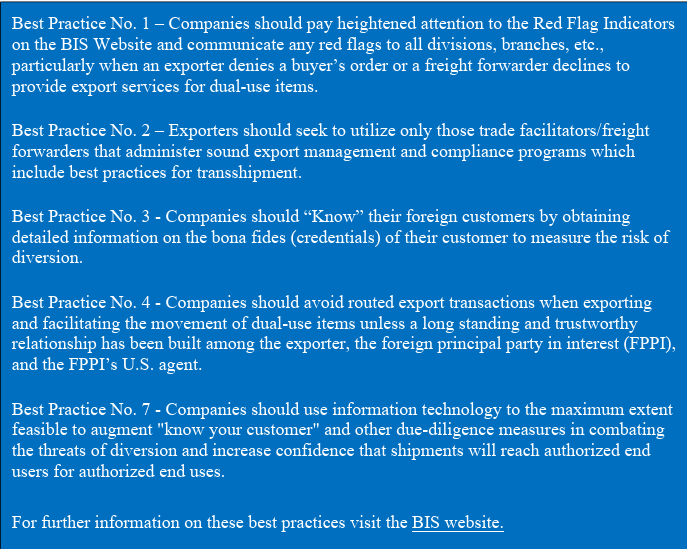
The best practices identified herein are intended to help industry guard against diversion risk. Both government and industry recognize that implementing effective import and export compliance programs is an important component of responsible corporate citizenship and good business practices.
